This post is Part 3 of a series on social revolutions of the past 30 years — where public consciousness has massively shifted in favor of liberation. My aim is to create space to pause and acknowledge how things have changed in ways that once felt impossible, remind us that things can always be otherwise. It is inspired in part by Rebecca Solnit’s 2016 edition of Hope in the Dark and David Graeber’s 2007 essay “The Shock of Victory.”
Feel free to check out part 1 and part 2.
When I was a kid, growing up in the early 2000s USA, the words “communist” and “socialist” were pretty much equivalent to “Satanist.” (okay to be fair my parents may have been a bit more extreme than most: they also thought Yoga was inviting demonic possession and Harry Potter was converting children to witchcraft, but I digress).
But as of 2026, both New York City and Seattle elected self-proclaimed Democratic Socialist mayors: Zohran Mamdani and Katie Wilson, respectively.

Mayor Katie Wilson of Seattle, Mayor Zohran Mamdani of New York City
Although both have faced criticism from Right as well as Left wing sources (either for their espoused views or failure to follow through on them), the fact two major US cities were able to elect openly socialist candidates is a major milestone in public perception.
In this post, I’ll explore a brief history of socialism in US culture and analyze some of the trends over recent years which show movement toward popular awareness of the fundamental problems of Capitalism and increasing willingness to experiment with alternatives.
Class consciousness? Hardly know her.
People who work for a living vs. people who own stuff for a living have very different interests: think about an Amazon warehouse worker vs. Jeff Bezos (or more accurately Andy Jassy, but he doesn’t have his own Bo Burnham song).
I would trace contemporary class consciousness in America in part back to the Occupy Wall Street movement in early 2010s, where de-centralized protestors took over Zucotti park in New York City in opposition to the rule of finance capital over our lives and popularized the slogan “We are the 99%.”

protestors on the steps of London Stock Exchange in 2011, source: Ilias Bartolini
Protestors were bringing to light the fact that, at the time, the top 1% of the population owned 43% of wealth. Since then, things have only gotten worse, with just 3 people owning more wealth than the bottom half of the country, and there is widespread despair of class mobility.

chart source: wikipedia contributor RCraig09 based on World Inequality Database
Speaking of shifting perceptions of the ruling class, we can look at the public reaction to alleged assassination of the CEO of United Healthcare, which makes hundreds of billions annually off denied insurance claims, by a certain Italian-American individual.

Luigi Mangione in court in 2025, source: Steven Hirsch/New York Post via AP
The popularity of the alleged assassin, dubbed by Forbes as a “social media folk hero,” certainly demonstrated a massive shift in consciousness away from a world where billionaires and CEOs were seen as untouchable, aspirational figures to a world where the actions of individual, determined people can reach them.
It’s debatable whether one can call this celebration of alleged vigilante justice by hot guys “class consciousness” per se, but it is certainly a shift in public perception —against the ruling class, which shocked many news outlets at the time.
If we look beyond individual actions though, we can see shifts toward more large-scale collective organizing.
Our rising labor movement
Perhaps the most public recent labor rights struggle is the 2023 SAG-AFTRA strike, which stretched on for four months and focused on putting protections in place to defend creative workers against exploitation and replacement by AI.
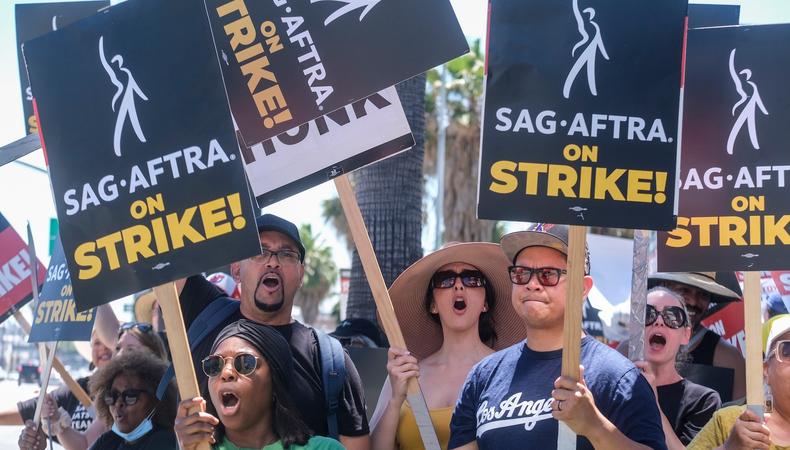
SAG-AFTRA strikers on the picket line in Los Angeles in 2023, source: Ringo Chiu/Shutterstock
Although labor union membership been sharply falling since the 1980s (mainly due to shipping US manufacturing jobs overseas and prolonged repression of organizing by capitalists and the government), the year 2025 marked a 16 year high in union membership, increasing from 14.2 million to 14.7 million people compared to 2024.
That’s an extra 500,000 people who joined unions last year. Public approval of unions is at 70%, which is the highest it’s been since the 1960s. Labor organizing has long been seen by leftists as a crucial part of any revolutionary strategy, with the General Strike being considered “the most powerful weapon of the working class” by the International Workers of the World (IWW, sometimes called “the wobblies”).
Thinking of militant unions as part of a broader strategy to build socialism, we can look to the past to see how labor unions have fought for and won serious victories.
Why was socialism ever unpopular?
If you ignore the half-century long conflation of communism and socialism with authoritarianism, it seems like a pretty easy sell (capitalist pun intended): who wouldn’t want to live in a society where basic needs of living are covered? Where everyone gets what they need — housing, healthcare, and public transportation — and where we get to directly control our own workplaces and decide what happens in our communities?
People generally don’t like feeling exploited or spending their lives under the thumb of one unaccountable boss after another. Most people recognized this in the early 20th century and were prepared to do something drastic about it.
Jumping back in time to 1912, dues-paying members of the US Socialist Party reached a peak of 113,000, while a massive series of worldwide strikes and militant labor actions forced governments and capitalists into compromises that led to the eight-hour workday and many of what are commonly called “New Deal Era Reforms” (which is a term that conveniently leaves out the labor struggle that was fought to win them).
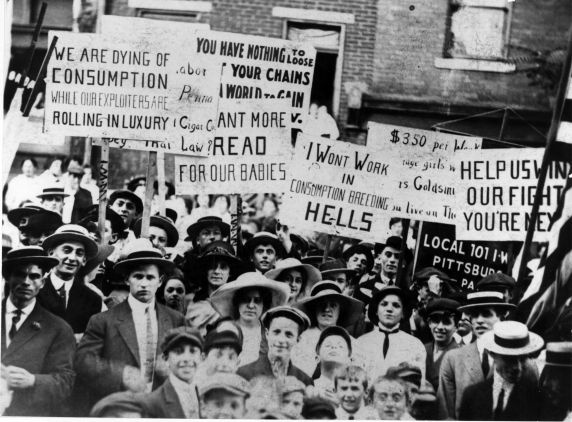
Tobacco Strike, Pittsburgh, Pennsylvania, 1910s, source: Walter P. Reuther Library
These reforms no doubt improved lives, particularly in establishing the US social safety net during the FDR era, and expanding to include Medicare during Lyndon B. Johnson’s “Great Society” era. (and which both parties have been gradually eroding since 1970).
But as positive as they were, these Democratic Socialist reforms of the New Deal represented a significant compromise against full-worker democracy and overthrow of the government, as was carried out in the 1917 Russian Revolution.
Although the USSR eventually descended into authoritarianism, the initial February Revolution was led by village “soviets” (meaning council or assembly in Russian): hundreds of autonomous, grassroots community assemblies who revolted against the Tzar to redistribute land and self-manage their own communities.
The Bolsheviks seized power later that year, claiming to represent the soviets and co-opting their slogan “all power to the soviets,” then proceeding to systematically squash them, suppressing hundreds of peasant revolts against the Bolshevik government which continued well into the 1920s.
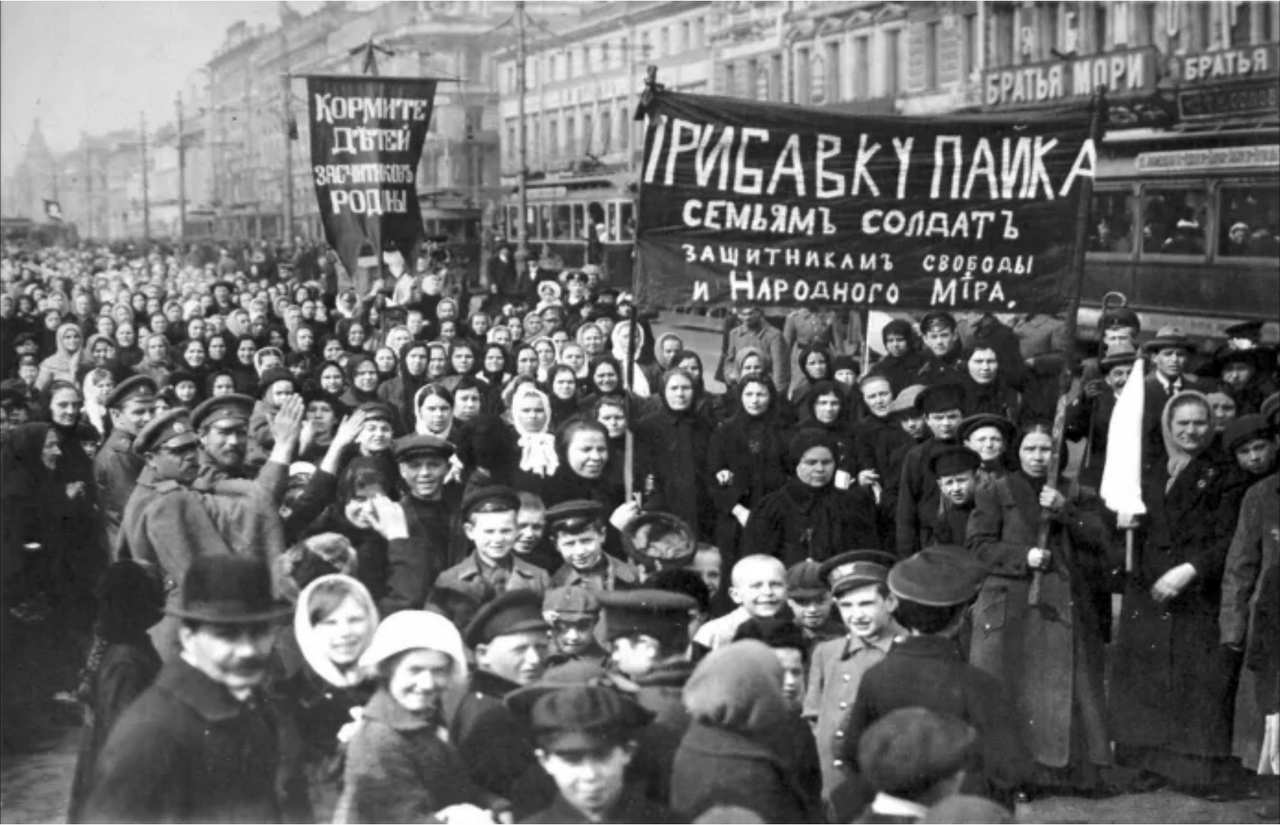
Workers strike in 1917 on the first day of Russia's February Revolution in the capital Petrograd, now known as St Petersburg. source: Getty Images.
The US government and its capitalists really didn’t want to risk a repeat of that.
The Spectre of Communism haunted many Western powers over the rest of the 20th century. Socialism as an ideological position has been strongly repressed in US culture since at least the 1950s, particularly with the COINTELPRO, where the FBI infiltrated and intentionally sowed distrust and disorganization in US Leftist organizations, sometimes engaging in agent-provacateur methods to entrap organizers and discredit groups centered on grassroots social change as violent radicals.
Or other times they just straight up murdered revolutionaries in their beds.
What really frightens the ruling class

Fred Hampton speaks at a rally in Chicago's Grant Park in September 1969. source: Chicago Tribune/Tribune News Service via Getty Images
Perhaps the most famous FBI assassination (that is, if you skip over the speculation that the FBI killed Martin Luther King, Jr.) is that of Fred Hampton, Chairman of the Chicago Black Panther Party — who was murdered at 21 years old, asleep next to his eight-month-pregnant fiancée, along with a friend who was attempting self-defense.
At the time, Fred Hampton was spearheading the multi-ethnic, multi-cultural Rainbow Coalition — which included recruiting from Black and brown faith communities, white Appalachians, labor unions, and Puerto Rican street organizations like the Young Lords, altogether aiming to demonstrate how much stronger we all are when we unite across difference.
I think often of my favorite Audre Lorde quote, from her famous The Master’s Tools Will Never Dismantle the Master’s House speech:
Within the interdependence of mutual (nondominant) differences lies that security which enables us to descend into the chaos of knowledge and return with true visions of our future, along with the concomitant power to effect those changes which can bring that future in being.
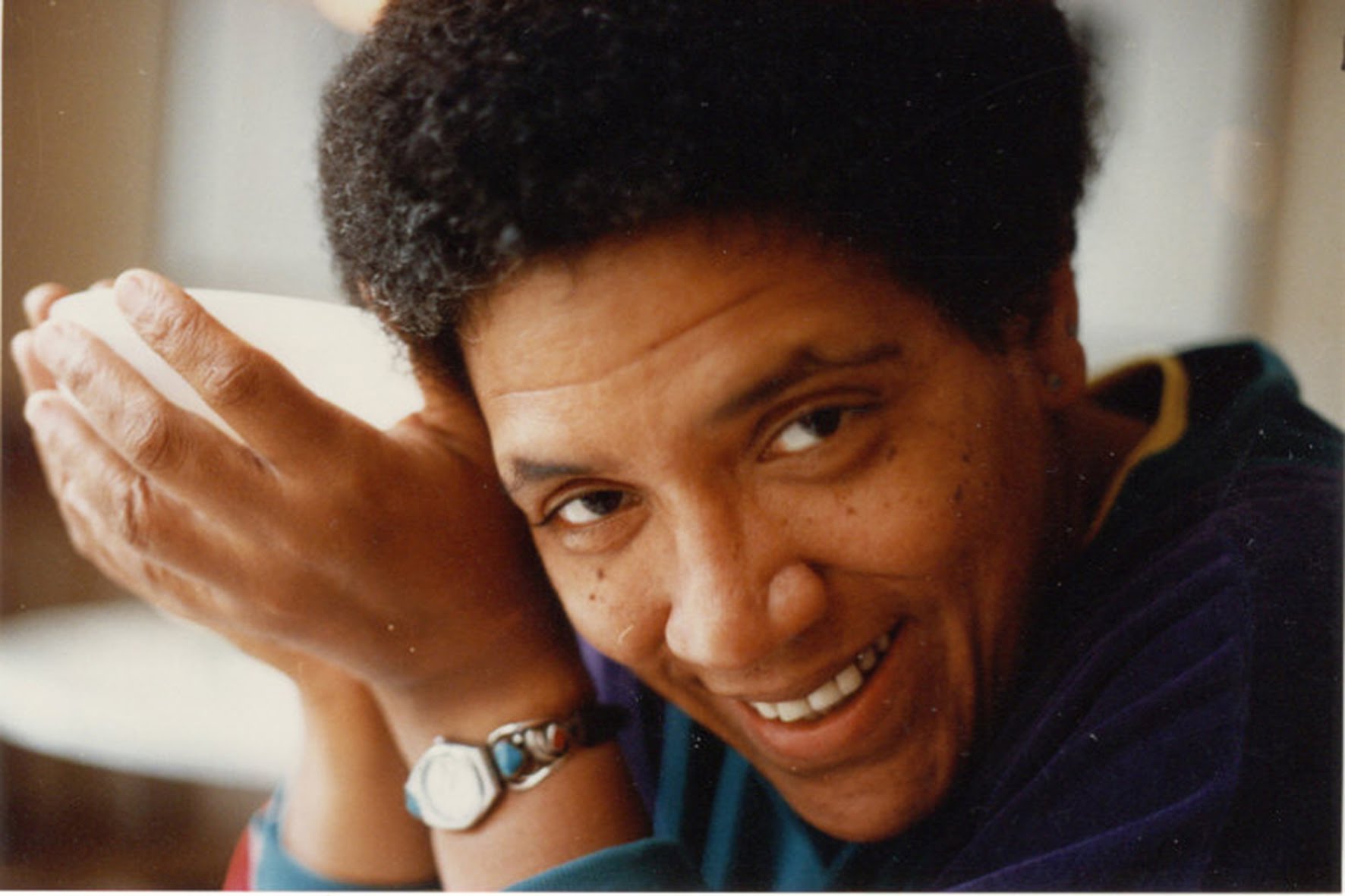
Audre Lorde, photo source: La Critica
Together, when we reach across difference, we can find a shared power in the gaps: an emergent property of coming together with openness and integrity.
The Backlash
The backlash against class consciousness — against the awareness of the obvious injustice of the economic order — has historically been distraction and misdirection. Lately you have the rise of “hustle and grind culture,” where the global problem of capitalist exploitation is to be solved by just “getting on your grindset:” working yourself harder than some hypothetical other who is presumably less deserving.
Despite 70% of Americans approving of labor unions, only ~10% of US workers are unionized. This is due to a deeply unfriendly regulatory environment, including gig work replacing much full-time employment, “bossware” and algorithmically driven labor management, and the large-scale shift away from traditional workplaces (like an office or factory floor), where workers could historically spend time with one another in person, making it much harder today to form trust and a sense of solidarity.
A whole ecosystem of hustle culture grifters has grown up to try to convince people caught in this trap that they have the secret solution that can get their followers out of this rigged game. Many such grifters, like accused international sex criminal Andrew Tate, appropriate the metaphor of “escaping the Matrix” as a way to describe getting yourself out of a position of exploitation… so you can become the guy stepping on the other guy’s throat.

It’s Deeply ironic to see the allegory of The Matrix accurately clocked as a depiction of Global Capitalism, but to envision not the destruction of the Matrix or building something beyond it, but simply becoming the oppressor yourself.
The gig economy has positioned itself in terms of “being your own boss,” we have mass proliferation of get rich quick schemes like NFTs and now AI, and above all the sheer overwhelming distraction of the internet, with hundreds of thousands of accounts trying to convince you they have the solution to your individual problem. Some of these solutions are relatively harmless (if pseudo-scientific), like those peddled by the manifestation and crystals crowd; but others are the virulently corrosive, like QAnon.
The Mirror World
There’s a famous saying in leftist circles that “anti-semitism is the socialism of fools.”
Essentially, what it means is this: many people are able to correctly identify that the world is run by a small number of elites with fundamentally unjust economic control and exploitation of everyone else. Buuuuttt, there is a large number of people who will then incorrectly identify the cause of this state of affairs as “THe JEwS!” — with many uncountable dog-whistles like “George Soros” or mentions of “shekels changing changes.”
Many other forms of scapegoating have analogous roles in distracting from the structural causes of harm: blaming immigrants for economic crises, Black mothers for crime, trans people for harm to children, Iran for a war the US started, and on and on.
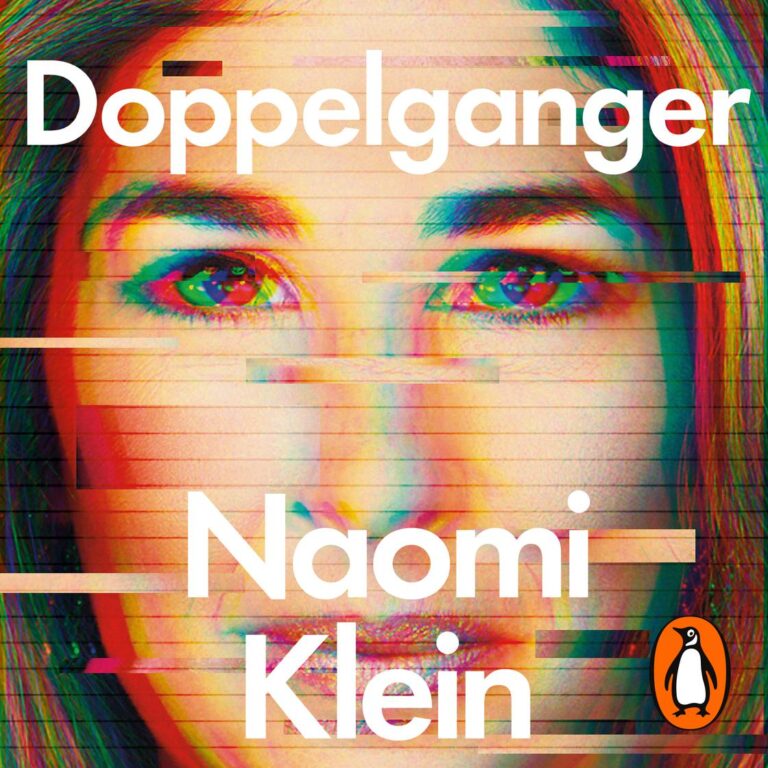
In her excellent 2023 book Doppelganger: A trip into the Mirror World, writer and activist Naomi Klein explores the contours of this alternate reality which many right-wing people seem to live in, where they come right up to the edge of an accurate systemic critique, but then veer off into moon-logic and end up blaming a marginalized group for problems caused by the ruling class and centuries-in-the-making structures of global oppression.
Who’s getting desperate…
Despite the very real fascism raging in the US and many other places worldwide, it seems to me that the ruling class hasn’t been this desperate in a long time.
Trying to recruit new ICE agents is reportedly quite difficult with public disapproval at an all-time high — even given just how low they’ve made the bar. The Atlantic reported that the administration reduced the ICE training period from “five months to 47 days last summer—because Trump is the 47th president.... Now it’s 42 days.” Obviously this desperation for recruits, no matter how incompetent, means increased danger of cowboy types doing harm to the public, but it also increases the likelihood of ICE bungling their own operations due to inexperience.
The Bannon-Trump strategy of “Flooding the Zone” — overwhelming media with ceaseless, outrageous content so no one knows what to focus on and despair of ever having an impact — is not a strategy you deploy when you have an actual plan to solve real problems. They are just trying to keep people distracted enough, long enough, to slip their corporate buddies a few extra dollars and give their oil bedfellows time to squeeze the last few drops out of the ecosystem before everything is on fire.
But even in the face of this horror are signs of growing grassroots, community power.
What is on the horizon
Along with recent increases in union membership and plans for a possible General Strike in 2028 spearheaded by the United Auto Workers, there has also been a 34% rise in worker cooperatives in the US since 2020, more than doubling their workforce!
Cooperative economics have long been proposed as a way to establish dual power: spaces of greater autonomy and freedom which coexist in the cracks of capitalism and the State, where we can practice the kind of relations we want to have with each other right now.
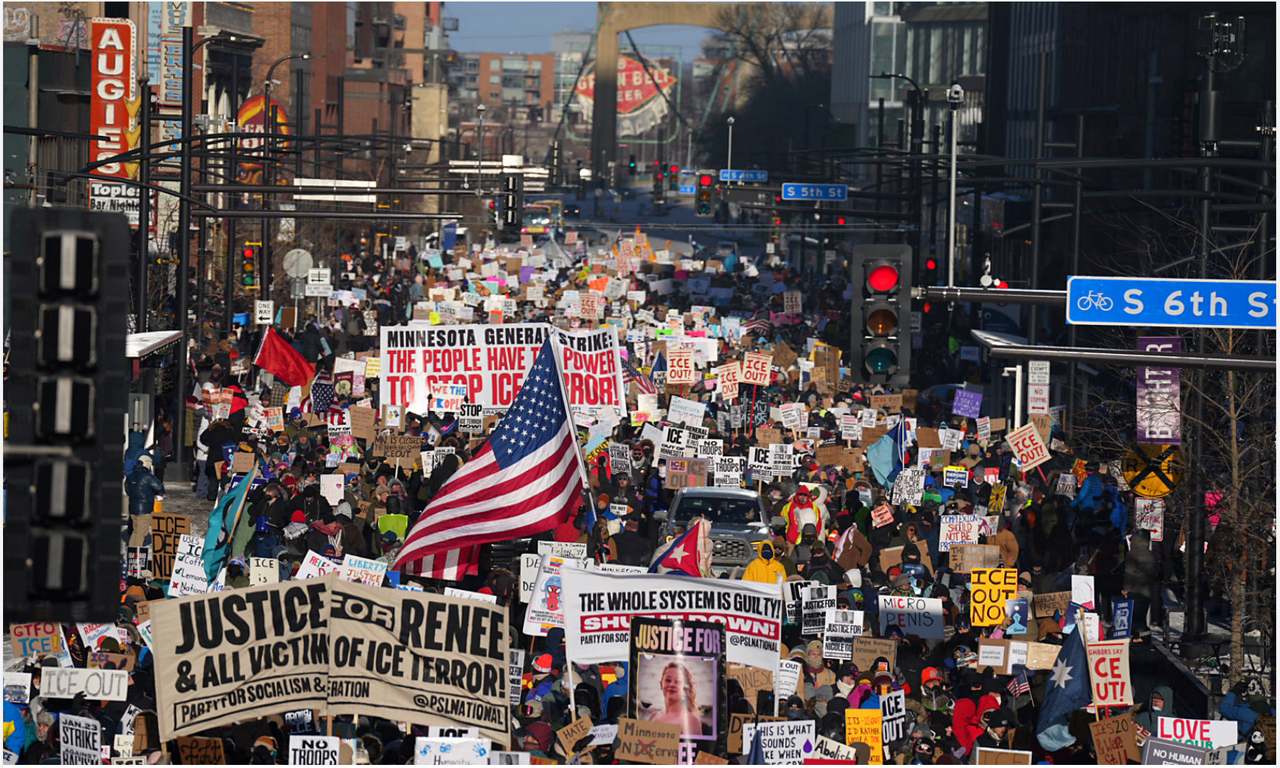
Minnesota anti-ICE protests, source: Coop News
On the housing front, more people are joining tenants unions, and more people are realizing housing is a human right and shouldn’t be left to the whims of the market, that unhoused people are not the cause of homelessness. Neighbor unions are digging into the radical potential of place-based community organizing.
Even less explicitly radical trends like “quiet quitting” and “I don’t dream of labor” discourse show people understanding their interests are not the same as their bosses’ interests, and taking steps to reclaim autonomy.
Where will the next developments in anti-capitalist organizing bloom? Radical labor unions? Solidarity Cooperatives? Workplace occupations? Neighbor unions?
Let’s try em all and see what sticks.
Suggested reading
- Agents of Repression: The FBI's Secret Wars Against the Black Panther Party and the American Indian Movement, by Ward Churchilland Jim Vander Wall
- Fight Like Hell: The Untold History of American Labor, by Kim Kelly
- Solidarity Economics: Why Mutuality and Movements Matter, by Chris Benner and Manuel Pastor
#socialrevolution #writing #revolution #education #essay #socialism #communism #capitalism #DSA #seattle #NYC #Mamdani #coops #NaomiKlein #AudreLorde #anarchism #wearethe99percent #occupy #SAGAFTRAStrike #generalstrike #neighborunion #laborunion #strike #IWW #quietquitting #idontdreamoflabor #COINTELPRO #solidarity #community #history #radicalhistory #TheMatrix #BlackPanthers #BPP #FredHampton #RainbowCoalition

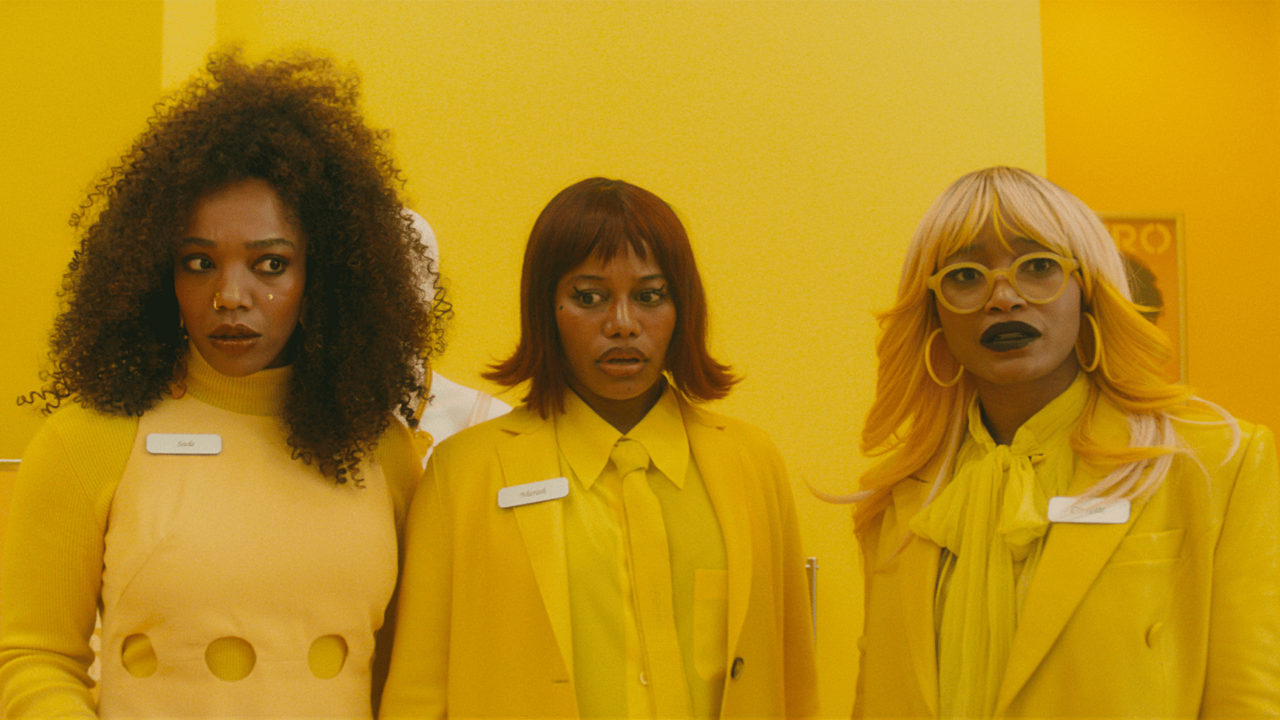 I Love Boosters, dir. Boots Riley, source: SIFF
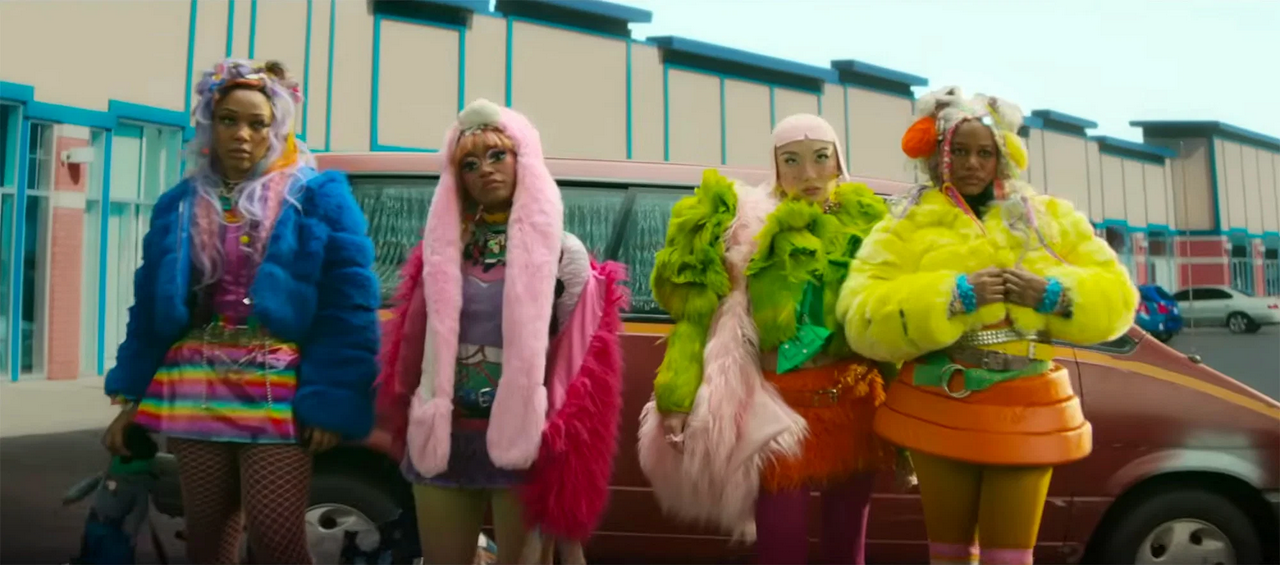 I Love Boosters, dir. Boots Riley, source: FirstShowing
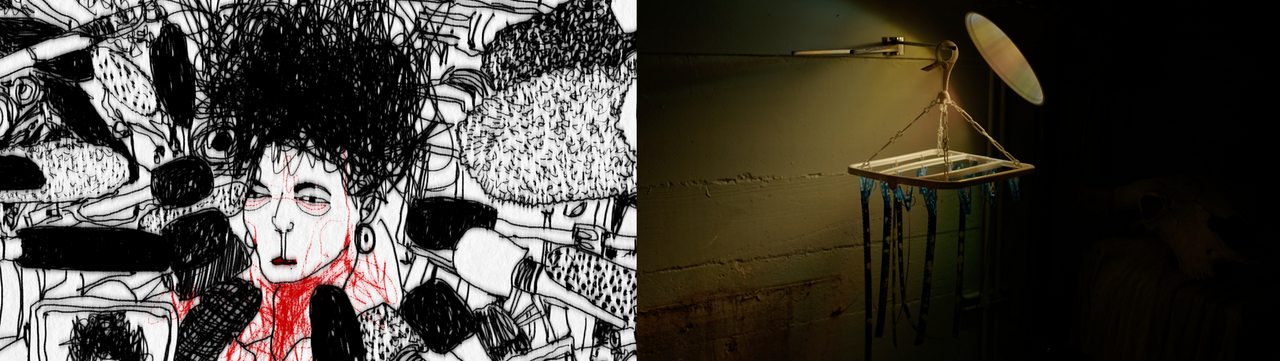 Left: Force Times Displacement, dir. Angel Wu, source: SIFF Right: refrigerator hum, dir. Jade Wong, source: SIFF.
 Materia, dir. Alisi Telengut, source SIFF
 Deadline, dir. Kiwi Chow, source SIFF.
 Becoming Human, dir. Polen Ly, source: SIFF

 Tarkovsky films, clockwise from left: Stalker, Nostalghia, The Sacrifice, and Solaris, source: StudioBinder