Social Revolutions of my Life – Police and Prison Abolition
This post is Part 2 of a series on social revolutions of the past 30 years — where public consciousness has massively shifted in favor of liberation. My aim is to create space to pause and acknowledge how things have changed in ways that once felt impossible, remind us that things can always be otherwise. It is inspired in part by Rebecca Solnit’s 2016 edition of Hope in the Dark and David Graeber’s 2007 essay “The Shock of Victory.” Feel free to check out part 1.
I remember when I first heard the phase “abolish the police” back in 2020, I thought it was pretty much fantasy. I had grown up on copaganda movies and TV and immediately thought “but who’s going to catch all the murderers and rapists?!”
Once I had done some digging and learned oh, actually cops are NOT catching many murderers or rapists, my next logical question was, “okay so what’s your alternative?”
In this blog post, I will explore the evolution of mainstream ideas about policing and how we’ve shifted our focus away from reform efforts (which have failed time and again), to building a multi-faceted constellation of alternatives to support human flourishing at all levels of society — instead of punishing people and locking them up which, beyond being inhumane, simply does not stop crime.

Are Prisons Obsolete? (2003) by the luminary Angela Y. Davis.
Despite mainstream liberals like former President Obama decrying it as too radical, the slogan “Defund the Police” brought what was basically a fringe position before the #BlackLivesMatter uprisings of 2020 to a topic of discussion on all major news outlets. You could see it on signs at protests, graffiti on walls, banners on buildings, posters in coffee shops, and chalk on the sidewalks.
This massive spotlight on anti-police and prison movements also influenced mainstream film and TV, with a 2021 article claiming that 127 episodes of television had addressed the Movement for Black Lives onscreen just that year, with popular “progressive” cop shows like Brooklyn 99 doing entire arcs responding to the uprisings, culminating in beloved characters leaving the fictionalized NY police force.

No matter how controversial the slogan may have been in 2020, “Defund the Police” brought what was formerly a radical activist position into the mainstream discourse. Even those who disliked the slogan admitted that they were for shifting funding away from law enforcement and toward education, social services, arts, parks, and other quality of life investments in public infrastructure.
The average moderate today is far more aware that social and economic issues are often the source of crime, that prisons reproduce criminals, that the history of modern policing lies in slave patrols and protecting private property — NOT in bringing murderers to justice.
Today, “abolish ICE” is a rallying cry across even formerly moderate groups, like Indivisible, which co-organizes the mass rally #NoKings protests.

Protestors holding up anti-ICE signs at Portland Protest in 2025, source: Daily Emerald
This is genuinely worth celebrating, because as much as it might feel like the scale of the 2020 BLM protests came out of nowhere, there is a long and rarely-told history of abolitionist organizing from at least 1970s with Black Feminists and the “Free Angela Davis campaign” — but we can connect it much farther back to the lineage of abolitionist organizing against slavery in the 1800s with formerly enslaved Black activists and intellectuals like Frederick Douglass and Sojourner Truth.
The Backlash
As always, when groups succeed in organizing for liberation or achieving greater visibility, there is a reactionary backlash of people and institutions who are afraid of freedom and feel threatened by marginalized people gaining power and autonomy. Far from defunding the police, since 2020 a majority of states and cities have increased their police budgets and increased police militarization.

Police in riot gear facing down a line of protestors. source: Indiana University Library
In my previous entry of this series, I talked about the backlash against revisionist history projects like the 1619 Project, which was intended to provide a long overdue counter-narrative to the glorifying mythology most Americans are taught about the founding of our country. I also outlined the escalating trend of charging non-violent activists with terrorism. The anti-critical race theory (CRT) culture war also emerges out of the same milieu as anti-BLM backlash.
But despite all the effort Republicans put into misinformation and fearmongering, nowadays, you’ll hear even previously moderate progressives say ACAB, particularly with the escalation in violence against even non-violent white citizens like Alex Pretti and Renee Nicole Good.
Today, even older white moderates are, for the first time, identifying law enforcement as a source of danger and not protection. In the past, this type of violence has largely been confined to borders, prisons, concentration camps, and BIPOC communities more generally, but with the extreme escalation of Trump 2.0’s ICE, we are seeing plainly the oft-quoted words:
The truth is, no one of us can be free until everybody is free.
-Maya Angelou
What I see as the biggest risk in the current phase of mass participation, rally-based politics which center narrowly on abolishing ICE and removing Donald Trump from office, is that framing the problem as confined to these issues discourages deeper questioning of the structures and institutions which are foundational to America.
My biggest fear
Calling ICE “the gestapo” (as I myself have in a video essay, analyzing the ties between a certain yogurt CEO and the Department of Homeland Security) is accurate in a sense of drawing a necessary comparison between the contemporary fascism of the Christian Nationalist regime of the US to that of Nazi Germany; on the other hand, calling ICE the gestapo conveniently distances ICE from the broader institution of US policing, making it seem like a complete and unprecedented aberration, when in reality, this is an expansion of the practices baked into America from its very founding by slave-owners who enjoyed waxing poetic about Liberty — as uncomfortable as that makes many of us (and it’s clear it makes Republicans VERY uncomfortable).
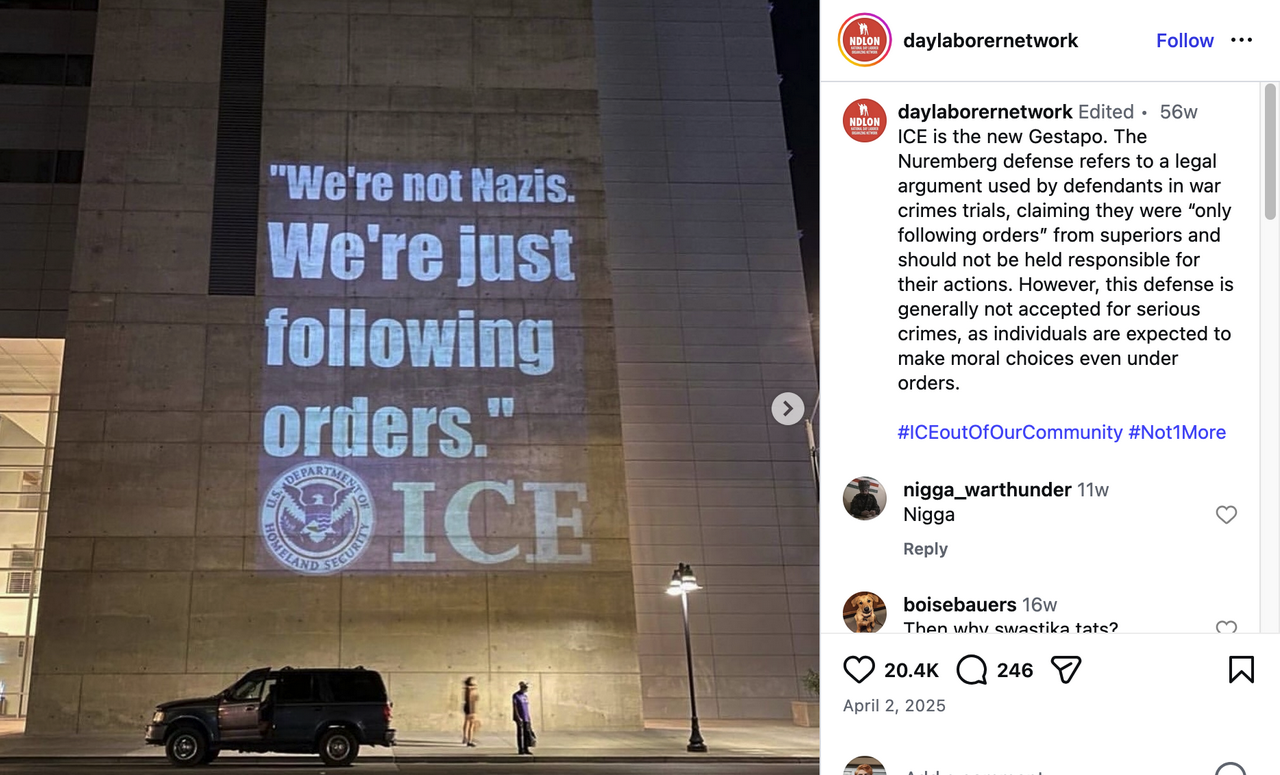
The influential Brazilian educator and theorist Paolo Freire refers to this type of cultural consciousness — where people are aware there are problems in society, but tend to view those problems quite narrowly — as Naive Transitivity, which he defines:
An over-simplification of problems; by a nostalgia for the past; by underestimation of the common man; by a strong tendency to gregariousness; by a lack of interest in investigation, accompanied by an accentuated taste for fanciful explanations; by fragility of argument; by a strongly emotional style; by the practice of polemics rather than dialogue; by magical explanations - Freire, Education for Critical Consciousness (1997): p. 18
When I see bumper stickers saying “No one is above the Law” or “Impeach Trump” or “Veto the Cheeto” — and the basic “No Kings Since 1776,” it’s clear that these people are invoking rose-colored ideas of American Democracy, simplistic appeals to a more polite and professional era of politics, and a nostalgia for the American Revolution.

Slogans that center on a single action, imagining that “the problem” would be solved if we simply got rid of Trump or got Congress to veto his laws are oversimplifications of structural problems. Many of Trump’s actions are carried out by Executive Order, far easier to wield than a 2/3 supermajority in a body of government engineered to be disconnected from democratic oversight the very existence of the Senate represents founders’ fears that too much democratic control would be dangerous! The system is not broken; it is functioning as intended, keeping and consolidating power in the hands of the already powerful.
My biggest hope
Putting aside my skepticism that the large number of people attending anti-Trump rallies are really questioning the roots of American imperialism or white supremacy, I am seeing a tremendously inspiring trend emerging in bottom-up democracy: the rise of Neighbor Unions — a relatively novel form of autonomous place-based organizing. The Institute for Social Ecology defines them:
an organization dedicated to building a community of solidarity at the scale of a neighborhood, and empowering that community to strive toward self-governance. Through welcoming events, consistent outreach, relationship building, and practical projects, organizers work to help people overcome their sense of isolation and powerlessness by getting to know their neighbors, supporting each other in concrete ways, and participating directly in the process of reshaping local life for the common good.
Neighbor Unions emerge from Murray Bookchin’s work on Social Ecology, anarchism, direct democracy self-management experiments like the Rojava Revolution, indigenous consensus-based governance practices going back thousands of years, and the experiences of community assemblies in the #Occupy Movement. Neighbor Unions are fundamentally grassroots and broad, not locked into insular sectarian debates or stuck begging elected leaders to solve problems.
source: Institute for Social Ecology
Neighbor Unions are organizing locally to take care of our neighbors and build confidence in our abilities to self-manage and take direct action in our communities.
That includes restorative and transformative justice, like that practiced by women-led community mediators in Rojava, advocacy and prison diversion programs like the Restorative Justice Initiative in NYC, the effective but ultimately underfunded experiment in 911 crisis call diversion CAHOOTS in Eugene, OR, and many other initiatives in the U.S. and around the world.
It’s not easy work to replace a system of structural policing and incarceration, but the very first step toward it is building trust with our local community and learning how to take care of each other.
Suggested Reads
- Are Prisons Obsolete?, Angela Y. Davis
- Healing Justice Lineages: Dreaming at the Crossroads of Liberation, Collective Care, and Safety, Cara Page & Erica Woodland
- Rattling the Cages: Dispatches from Behind Bars, AK Press
#writing #revolution #stopcopcity #blm #abolition #education #essay #defundthepolice #abolishthepolice #abolishICE #prisonabolition #prison #prisonlife #prisonbreakedit #freethemall #criminaljustice #endmassincarceration #criminaldefense #criminaldefenselawyer #accesstojustice #prisonart #notguilty #lawyers #endcashbail #court #wrongfulconvictions #endthedeathpenalty #criminaldefenseattorney #restorativejustice #transformativejustice